文章目录
- 21. 合并两个有序链表:
- 样例 1:
- 样例 2:
- 样例 3:
- 提示:
- 原题传送门:
- 分析:
- 题解:
- rust
- go
- c++
- c
- python
- java
21. 合并两个有序链表:
将两个升序链表合并为一个新的 升序 链表并返回。新链表是通过拼接给定的两个链表的所有节点组成的。
样例 1:
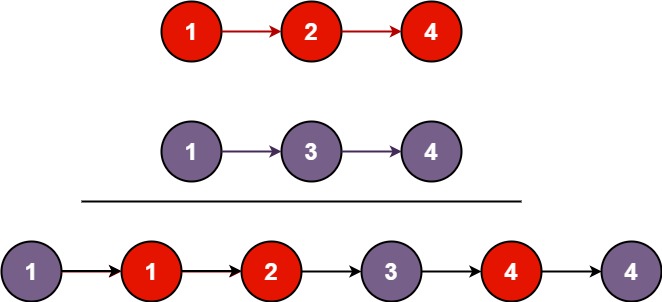
输入:
	l1 = [1,2,4], l2 = [1,3,4]

输出:
	[1,1,2,3,4,4]
样例 2:
输入:
	l1 = [], l2 = []

输出:
	[]
样例 3:
输入:
	l1 = [], l2 = [0]

输出:
	[0]
提示:
- 两个链表的节点数目范围是
[0, 50] -100 <= Node.val <= 100l1和l2均按 非递减顺序 排列
原题传送门:
https://leetcode.cn/problems/merge-two-sorted-lists/
分析:
- 面对这道算法题目,二当家的陷入了沉思。
- 合并有序链表或者合并有序数组非常像归并排序的合并部分。
- 递归和迭代都可以,通常递归更加简单直观,迭代更加高效。
题解:
rust
// Definition for singly-linked list.
// #[derive(PartialEq, Eq, Clone, Debug)]
// pub struct ListNode {
//   pub val: i32,
//   pub next: Option<Box<ListNode>>
// }
//
// impl ListNode {
//   #[inline]
//   fn new(val: i32) -> Self {
//     ListNode {
//       next: None,
//       val
//     }
//   }
// }
impl Solution {
    pub fn merge_two_lists(list1: Option<Box<ListNode>>, list2: Option<Box<ListNode>>) -> Option<Box<ListNode>> {
        match (list1, list2) {
            (None, None) => None,
            (None, r) => r,
            (l, None) => l,
            (Some(mut l), Some(mut r)) => {
                if l.val <= r.val {
                    l.next = Self::merge_two_lists(l.next, Some(r));
                    Some(l)
                } else {
                    r.next = Self::merge_two_lists(Some(l), r.next);
                    Some(r)
                }
            }
        }
    }
}
go
/**
 * Definition for singly-linked list.
 * type ListNode struct {
 *     Val int
 *     Next *ListNode
 * }
 */
func mergeTwoLists(list1 *ListNode, list2 *ListNode) *ListNode {
    if nil == list1 {
		return list2
	}

	if nil == list2 {
		return list1
	}

	if list1.Val < list2.Val {
		list1.Next = mergeTwoLists(list1.Next, list2)
		return list1
	} else {
		list2.Next = mergeTwoLists(list1, list2.Next)
		return list2
	}
}
c++
/**
 * Definition for singly-linked list.
 * struct ListNode {
 *     int val;
 *     ListNode *next;
 *     ListNode() : val(0), next(nullptr) {}
 *     ListNode(int x) : val(x), next(nullptr) {}
 *     ListNode(int x, ListNode *next) : val(x), next(next) {}
 * };
 */
class Solution {
public:
    ListNode* mergeTwoLists(ListNode* list1, ListNode* list2) {
        if (!list1) {
            return list2;
        }

        if (!list2) {
            return list1;
        }

        if (list1->val < list2->val) {
            list1->next = mergeTwoLists(list1->next, list2);
            return list1;
        } else {
            list2->next = mergeTwoLists(list1, list2->next);
            return list2;
        }
    }
};
c
/**
 * Definition for singly-linked list.
 * struct ListNode {
 *     int val;
 *     struct ListNode *next;
 * };
 */


struct ListNode* mergeTwoLists(struct ListNode* list1, struct ListNode* list2){
    if (!list1) {
        return list2;
    }

    if (!list2) {
        return list1;
    }

    if (list1->val < list2->val) {
        list1->next = mergeTwoLists(list1->next, list2);
        return list1;
    } else {
        list2->next = mergeTwoLists(list1, list2->next);
        return list2;
    }
}
python
# Definition for singly-linked list.
# class ListNode:
#     def __init__(self, val=0, next=None):
#         self.val = val
#         self.next = next
class Solution:
    def mergeTwoLists(self, list1: Optional[ListNode], list2: Optional[ListNode]) -> Optional[ListNode]:
        if list1 is None:
            return list2
        if list2 is None:
            return list1
        if list1.val < list2.val:
            list1.next = self.mergeTwoLists(list1.next, list2)
            return list1
        else:
            list2.next = self.mergeTwoLists(list1, list2.next)
            return list2
java
/**
 * Definition for singly-linked list.
 * public class ListNode {
 *     int val;
 *     ListNode next;
 *     ListNode() {}
 *     ListNode(int val) { this.val = val; }
 *     ListNode(int val, ListNode next) { this.val = val; this.next = next; }
 * }
 */
class Solution {
    public ListNode mergeTwoLists(ListNode list1, ListNode list2) {
        if (list1 == null) {
            return list2;
        }

        if (list2 == null) {
            return list1;
        }

        if (list1.val < list2.val) {
            list1.next = mergeTwoLists(list1.next, list2);
            return list1;
        } else {
            list2.next = mergeTwoLists(list1, list2.next);
            return list2;
        }
    }
}
非常感谢你阅读本文~
欢迎【点赞】【收藏】【评论】~
放弃不难,但坚持一定很酷~
希望我们大家都能每天进步一点点~
本文由 二当家的白帽子:https://le-yi.blog.csdn.net/ 博客原创~



![[附源码]JAVA毕业设计疫情防控期间人员档案追演示录像上(系统+LW)](https://img-blog.csdnimg.cn/f2d6fcefe57d4b3ca9bdebe74f2f62ae.png)




![[1.2.0新功能系列:一] Apache Doris 1.2.0 版本 Light Schema Change](https://img-blog.csdnimg.cn/img_convert/cf61d42f2d2a93189eeb2d09b1aa4d10.png)